The semiotics of spiking someone's drink
what nudges can tell you about you
(I mentioned at the top of the last post that a longer post is coming. This is still not that post. Anyway, the most pick-me but nevertheless truthful opening sentence to a substack essay you’ve ever seen incoming in 3, 2, 1 … )
So I was re-reading Notes from Underground and having a solo Guinness in a beer garden in Hackney this Monday. It was sunset-ish and the run clubs were just back and starting to fill the place out. I suddenly felt like the book’s protagonist, which isn’t a good thing.
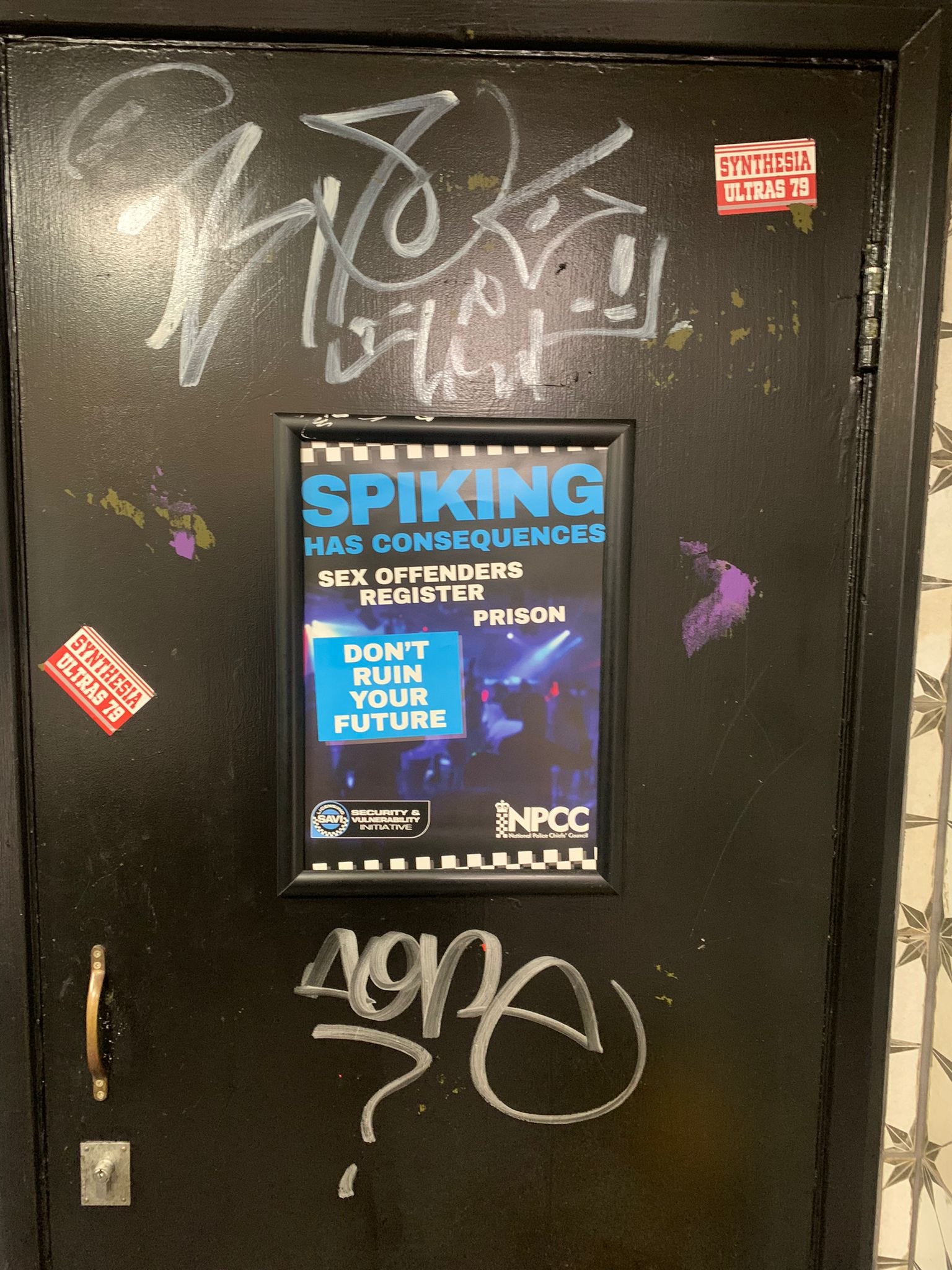
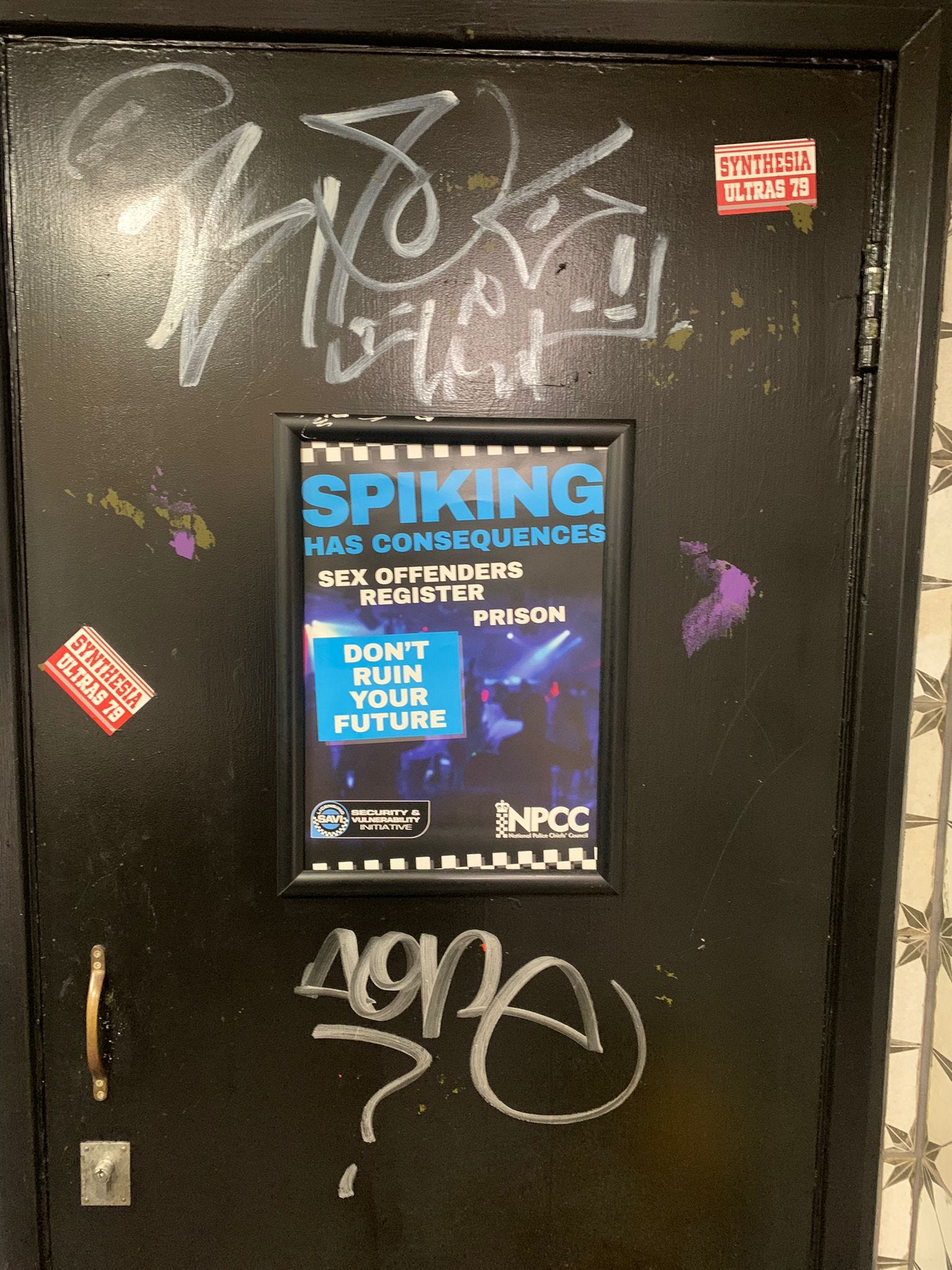
The move is quick trip to the gents’ before heading. Which is where I’m washing my hands when I have to double take at one of the posters on the stalls.
Here’s a photo:
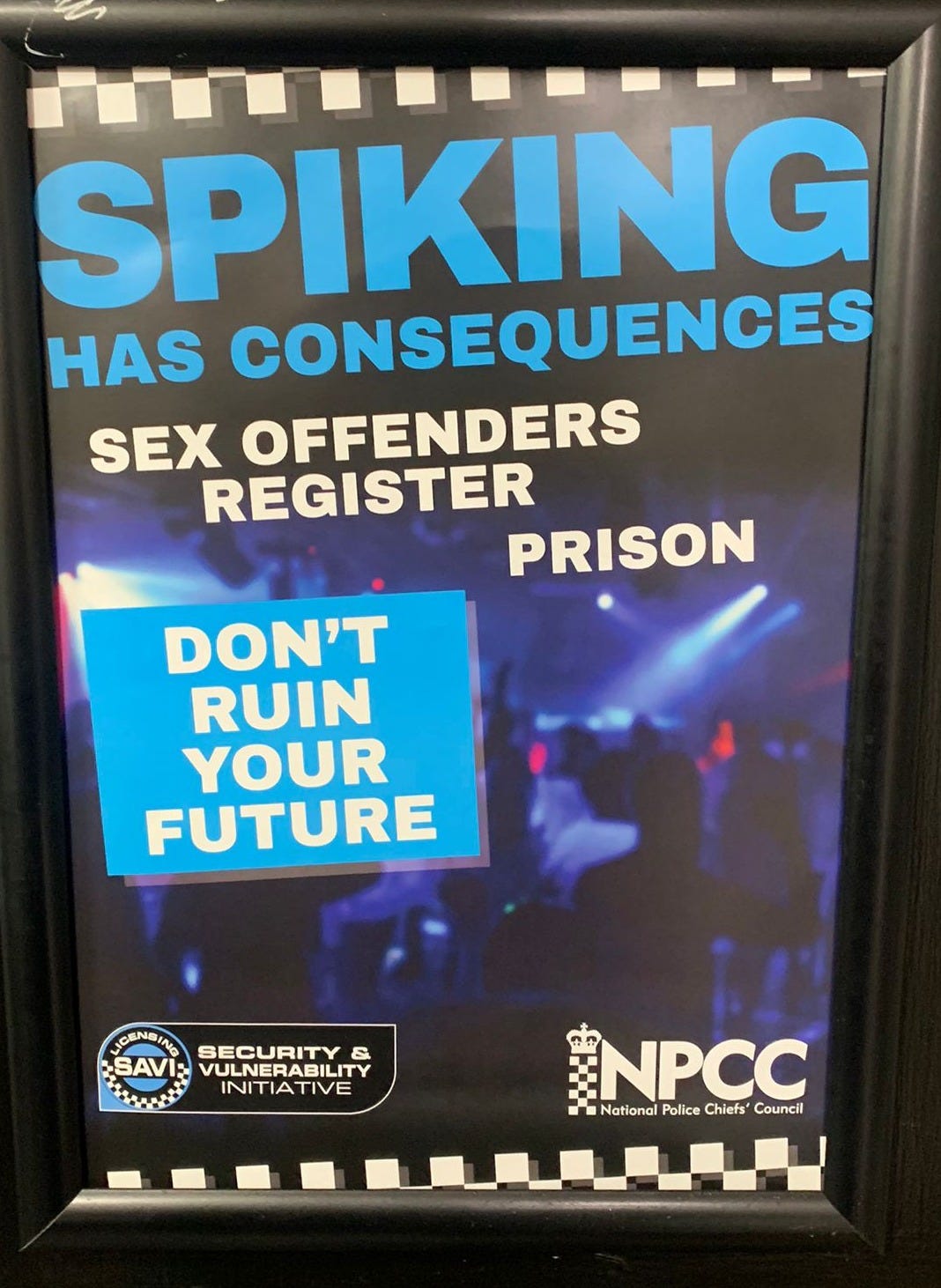
Call me a traditionalist, but I’m pretty sure the main consequence of spiking someone is that someone will have gotten spiked. And the reason we discourage young men from spiking people isn’t because it will ruin their own future.
OK, yes, fine. The police know that too. And fair enough, ‘spiking is immoral’ probably doesn’t work on the kind of person that would spike someone.
But this is what they settled on. A total of 2 different possible punishments, one impressively vague. And no mention of victims at all. The victim is the spiker.
“You’re only spiking yourself in the long run”, while absolutely more distasteful, would still be basically saying the same thing.
This is, however, pretty informative. Posters like this actually don’t tell you much about the people who designed them, but they tell you a lot about what those people think of you. And they think this could be likely to work.
In that case, let’s find out about ourselves.
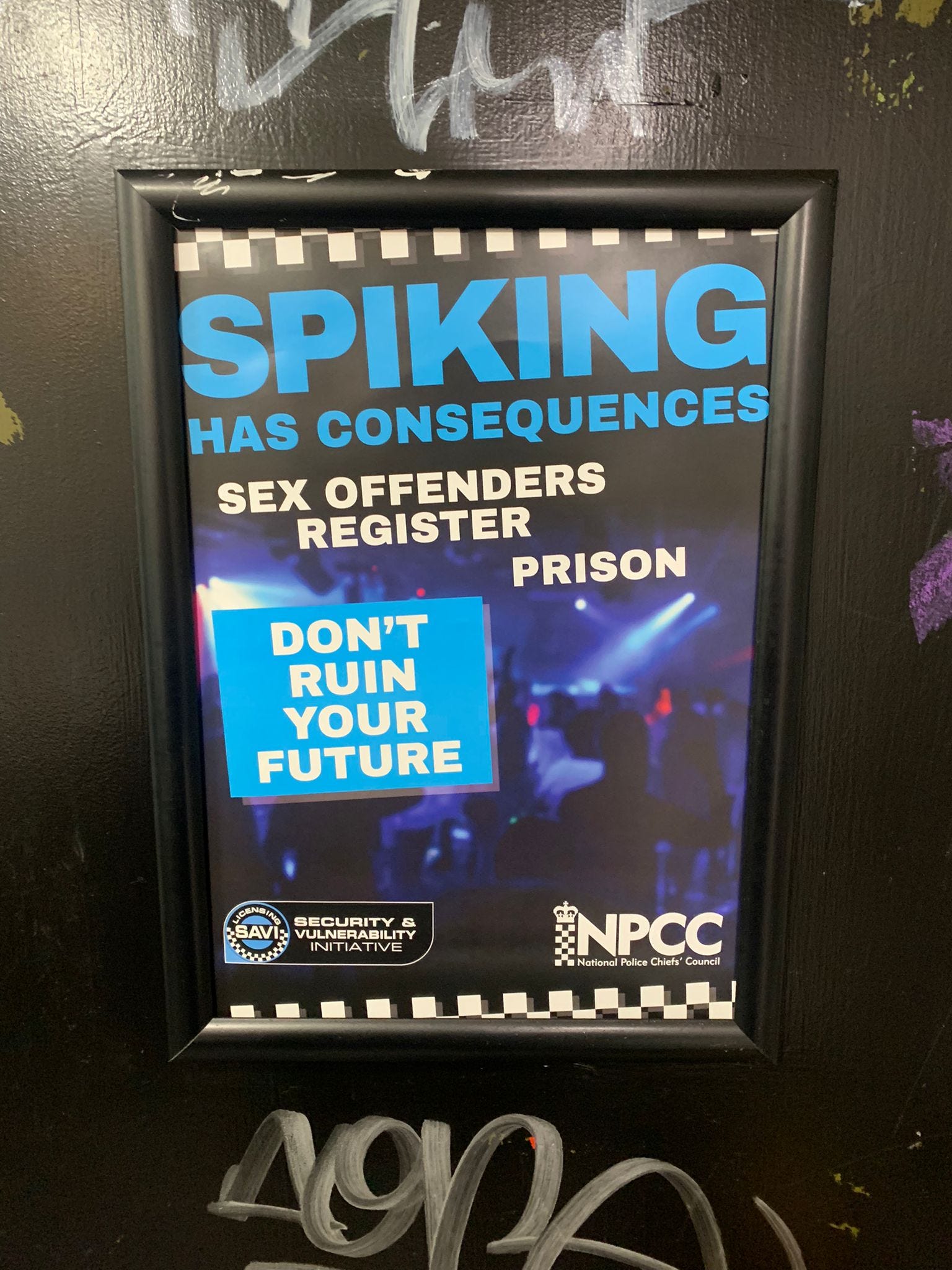
In a past life, I worked close enough to this sort of thing that I know for a fact a lot of thought probably went in here. So I Googled 'spiking poster dont ruin your future’, and … easy. Turns out I only saw one version.
Here’s the family photo:


That’s right, twerp: LIMITED EMPLOYMENT PROSPECTS.
Sorry, I actually am taking this seriously. That’s why this post exists. But I’m surprised that one made the cut.
The website says this:

“The drink spiking posters have been designed in conjunction with NCA behavioural scientists”.
I knew it would say that before I even left the pub bathroom. It has flavours of all the hits from behavioural policy design. This thing has elements of loss aversion, social norms/stigma, framing and priming effects. But also, I think that might stand for pretty much every crime prevention campaign (including the greatest ever). So why this and why now?
It’s gotta be empirically informed, so I performed a literature review (I searched Google Scholar for ‘nudging criminals to stop’). Didn’t find much, bar the most unhinged title and subtitle I think I’ve ever seen:

But as it turns out, there’s not much that’s been tried empirically. A lot of nudging people into the behaviours that prevent crime happening to you (locking doors etc.), but less on nudging criminals to stop. And zero on crimes this horrible.
It was at this point I realised you can’t really run randomised control trials on spiking behaviour.
So moving to a more abstracted theory, which may or may not work in this context, we probably have something like ‘focusing on the potential consequences is more effective than explaining why you shouldn’t do the thing at all.’
Or to re-frame to the individuals perspective: you’re not averse to doing bad things, you’re averse to being caught.
This means we can also talk about psychology a bit more. Here’s a map you may have seen in some undergrad lecture a long time ago:
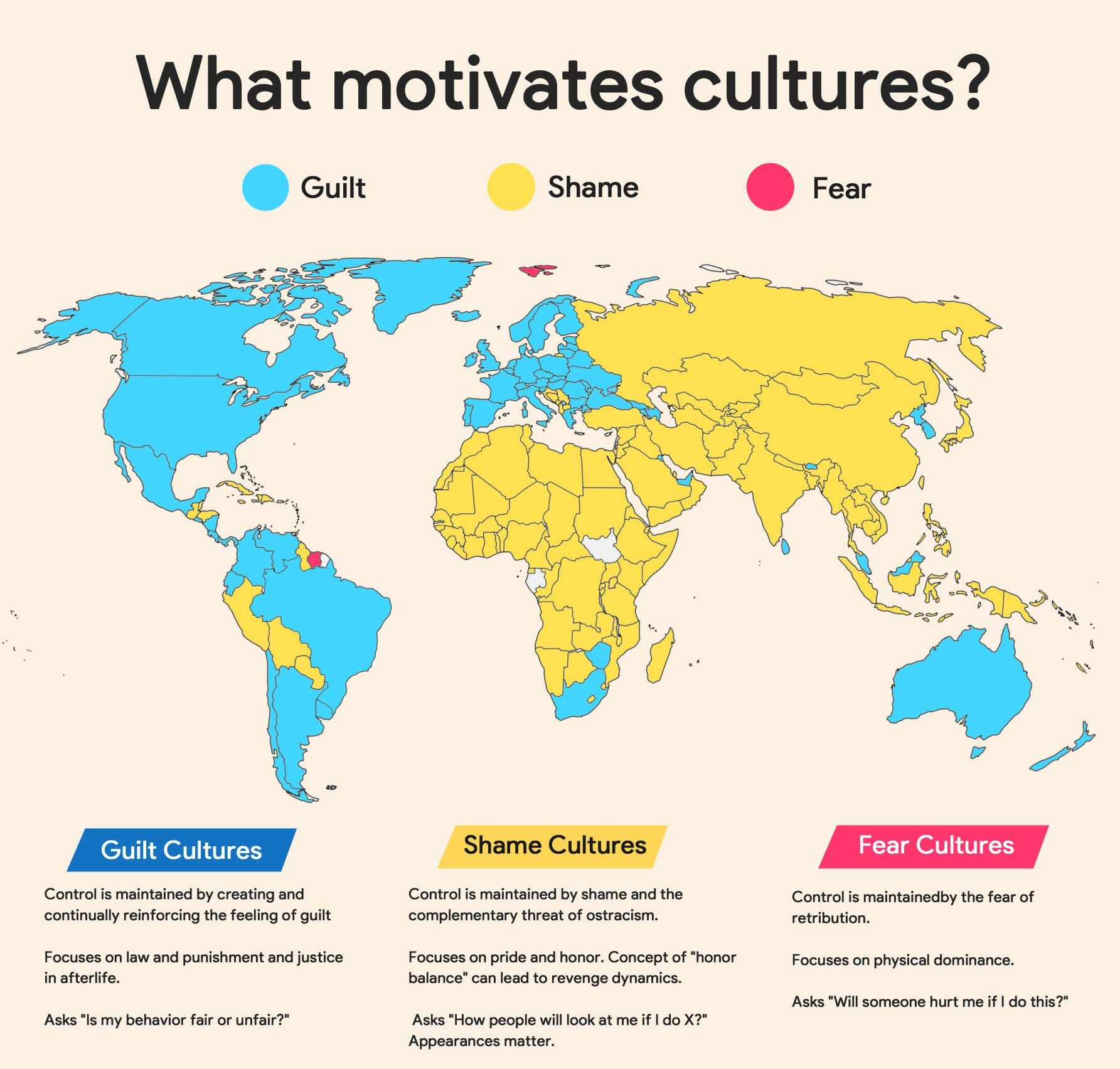
Let’s cut the fear countries out to save time and call this the ‘guilt-shame spectrum’. The question is how do cultures generally stop people from doing bad things, and the suggestion is that the West (and company) uses guilt and everywhere else uses shame.
There’s multiple reasons why I think this is way off, but let’s start with the definitions. Guilt cultures feature both a ‘focus on law and punishment’ and people asking themselves ‘is my behaviour fair or unsafe?’, as if a judge saying the word ‘guilty’ and the defendant feeling guilty are the same thing.
Unless you’ve turned yourself in, this is something else. The West has moved on.
Guilt cannot be created and reinforced externally, because that is not what guilt is. To go back even further in time than that map, let’s use the language of: id, ego, superego.
The superego is the part of your mind that acts like an internal judge, a voice that tells you what’s right and wrong based on all the rules and values you’ve soaked up since you were an infant. It forms through a mix of parental authority, societal norms, and cultural expectations—basically, everything from “don’t lie” to “don’t murder” gets wired in there. Freud thought it was the superego that made you feel guilty when you mess up, like a mental CCTV camera catching you in the act.
But this goes out of vogue in the 70’s and 80’s (hint: what was different about the world then vs 1900?), when Heinz Kohut and Christopher Lasch’s work on narcissism revealed a shift from the "Guilty Man" to the "Tragic Man".
This is really important.
In the past, the superego dominated, instilling guilt through an internalised moral order—breaking rules felt like an intrinsic failure. But as social and cultural contexts evolved, particularly post-1950’s, the focus moved away from internalised guilt to issues of self-esteem and a chronic sense of emptiness. Tragic Man is less concerned with inherent right or wrong and more with how he measures up to external ideals of success and admiration.
And the really really important part …
With the superego weakened, the drive to avoid shame rather than to feel guilt has become central, leading to a culture where personal value is determined by how you’re perceived, not by an internal moral compass.
Hence, people sometimes show support for causes they don’t care about, or disagree with.
Also, hence …
or to show you how it’s a bittt more complicated than that …
Let’s talk about a real tragic man. A non-criminal this time.
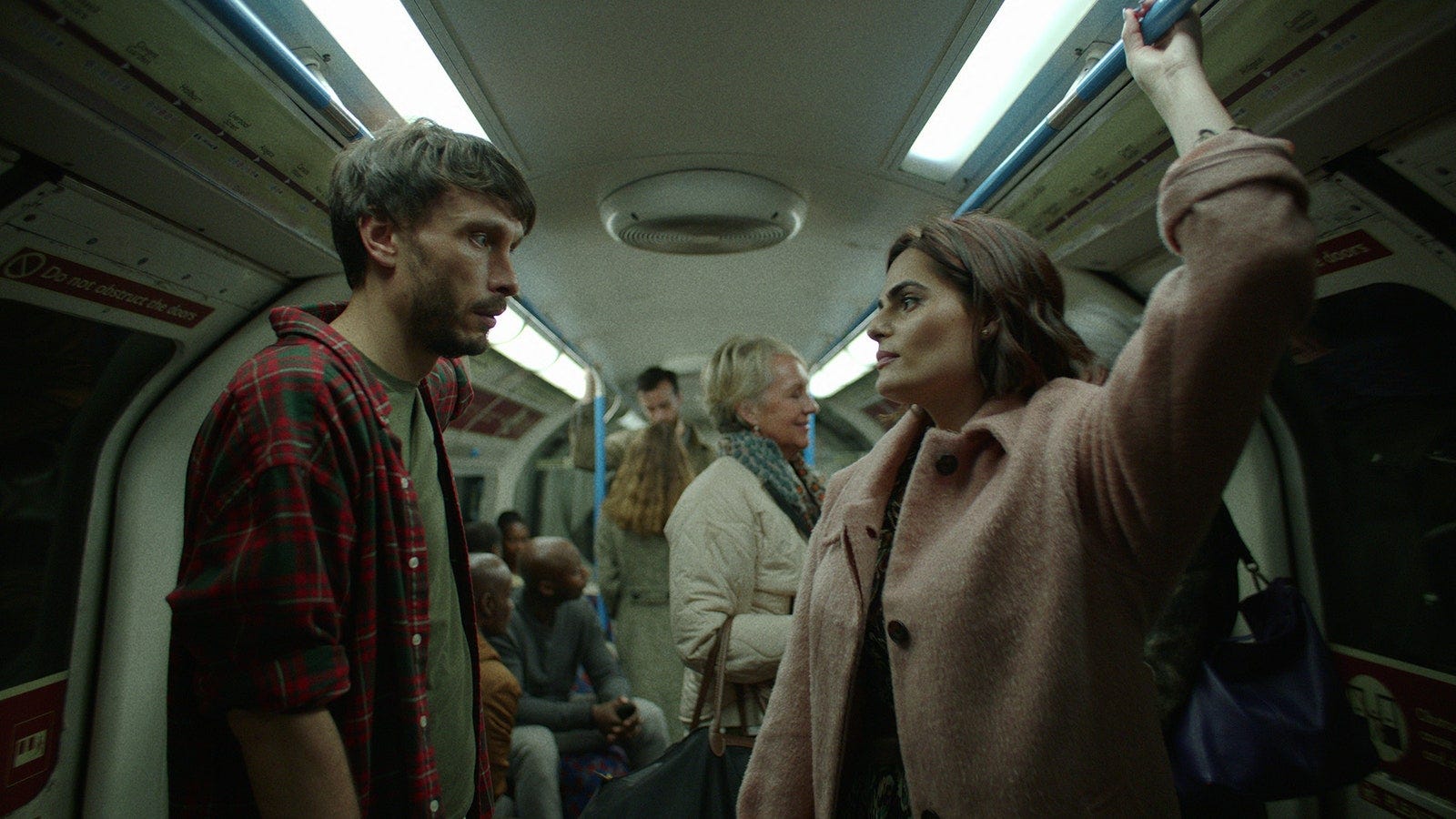
Everyone knows this blog is where you come for the most up-to-date cultural and media analysis fresh off the zeitgeist. So it’s only right that it’s September and we’re going to talk about Baby Reindeer.
The basic plot of the show: Comedian Donny’s life is upended when Martha becomes obsessively fixated on him after a brief encounter. Her stalking escalates, affecting Donny's relationships and mental health. Despite legal interventions, Martha persists. The story ends with Donny confronting Martha, leading to her arrest, but leaving him deeply traumatised. This is also something that actually happened to Richard Gadd (Donny) in the past.
(note: I think the show is amazing and it’s only because it is so good that the below observations are possible. I’m also going to have to assume it’s a pretty faithful retelling of the events. It will help if you have also seen the show, but might be ok anyway.)
The story takes up 7 episodes and goes across at least a couple of years. And surely quite a few people agree one of the most interesting parts of watching it was thinking ‘why on Earth is this show so long?’
By which I mean: why did it take Donny so long to say anything?
There’s even a moment 3 episodes in where he does decide to put a stop to it. He goes to the police station with all the evidence he needs. And he decides against using it. Why?
The secret is in this part from above: “the drive to avoid shame rather than to feel guilt has become central, personal value is determined by how one is perceived, not by an internal moral compass.”
And the show displays this well. Donny is clearly humiliated by who he actually is. The lengths he will go to stop people seeing how badly his life/career/everything is going are .. well .. we saw the lengths.
Understandably, when the show was what everyone was talking about, the main subjects of discourse were Martha and Darrion.
But I think this left out another fascinating relationship: Donny and Teri.
People reference it as a way to show that Donny/Richard is willing to show that he gets that he’s messed up too. He has desires he hasn’t worked out yet, and he’s trying to deny all the various parts of his life from colliding.
But here is one thing that can’t be denied: Donny treats Teri absolutely terribly.
A list:
- Initially lied about his identity, telling Teri he was a builder named Tony instead of being honest about who he was.
- Kept his relationship with Teri secret, suggesting he was ashamed of being with her.
- Abandoned Teri on the Underground when she asked him to kiss her in public, showing his discomfort with openly displaying their relationship.
- Failed to adequately address Martha's stalking behaviour early on, which eventually led to Martha verbally and physically assaulting Teri, including pulling out a chunk of her hair.
- Did not immediately report Martha's assault on Teri to the police, allowing the stalking and harassment to continue.
- Struggled with intimacy issues in their relationship due to his unresolved trauma, which he didn't fully address or communicate about.
- Hid in Teri's flat to avoid his own problems instead of dealing with them directly.
- Attempted to entrap Martha into violating a no-contact order, which backfired and led to Teri breaking up with him when he was cautioned by the police.
He shows no signs of guilt as these things happen. And it’s the threat of shame that’s causing them in the first place.
This is obvious, and uninteresting. It fits the model we’re already describing.
But there’s one detail that doesn’t quite fit.
And that is: if Richard Gadd was driven more by avoiding exposure than actually caring about people, then why on earth is all of this in the show?
I was back in the same beer garden yesterday, re-reading some old David Foster Wallace essays. Yes, I am that annoying guy you dated when you were 22. No, I still haven’t gone to South America.
Anyway, in E Unibus Pluram, on the nature and effects of television, DFW makes this remark:
Illusions of voyeurism and privileged access require real complicity from viewers. How can we be made so willingly to acquiesce for hours daily to the illusion that the people on the TV don't know they're being looked at, to the fantasy that we're transcending privacy?
Point being, Richard Gadd very obviously knows that I’m going to make the exact observation up there about how shitty he was to Teri. He’s trying to tell us all about it, but just not without the narrative that helps you get it.
He tells her he’s a builder because his comedy career just isn’t where he wants it to be. He avoids PDA because he isn’t ready to admit his sexuality isn’t as simple as he thought. He didn’t get her police protection because he wasn’t ready to face reality.
His identity came first. And he caused both of them harm because of it. Should he feel bad?
Fundamentally, he’s still letting us decide. And that’s some A-class guilt avoidance, right there. Because in a shame-based culture, guilt only counts if other people can confirm your intuition that you fucked up.
It’s no coincidence that the one moment in the show he actually admits to feeling bad about what he did to Teri, was on stage to a full room, that she just happened to be in the back of.
By these tactics, your superego isn’t internal anymore. It’s passed over to your audience.
And you know what, they may even let you off the hook.
My aversion to this, and to shame-based society in general, is pretty simple:
Learning a discipline is hard, passing an exam is easy.
A fully developed internal compass of right and wrong is essentially ‘prevention is better than cure’. You don’t do bad things because you don’t want to be a person that does bad things. It’s not like a type of suppression.
But to live in fear of shame? What if fear is calibrated?
By which I mean, if someone is scared being caught doing bad things, what does that mean for the bad things they don’t think they’ll get caught doing? The things we don’t know how to shame people for?
Speaking of horrible things that people have a low chance of being caught doing, some numbers for you:
- In a YouGov poll, 10% of women in the UK said they have been spiked in their life
- The UK police received almost 7,000 (74% women) reports of spiking in 2023. Up from ~5,000 a year prior, and from ~2,000 a couple years prior to that
- In London specifically, spiking rates have quadrupled in the last five years
- In the UK last year, just 61 people were convicted for spiking related offences
- One man convicted in 2020 had spiked and raped up to 200 men before he was eventually jailed
Which takes me back to the pub bathroom.
Everyone knows we live in a media-built culture where identity is paramount and people take the image of being a good person over the work it involves. Behavioural scientists get this too, which is why I guess this is good poster design.
But fuck me, what it says about everything else is seriously bad. The longer you go into using shame as a primary weapon, the better people get at avoiding it. The more complicated the tactics to deny having to confront yourself. Or the people you’re hurting. However small.
The question it’s too late to ask is how you stop that process from happening.
The real question is this: what are the fucked up things you do that you’d only feel bad about if people found out?
What’s that, there isn’t anything tearing you up?
Yeah, well, I guess that part makes sense.
As a note to end on: don’t spike people.