What is The White Lotus for?
'C' = D x V x F < R

Back to the long posts after this one. Going to be fun. Sorry for the wait.
0.
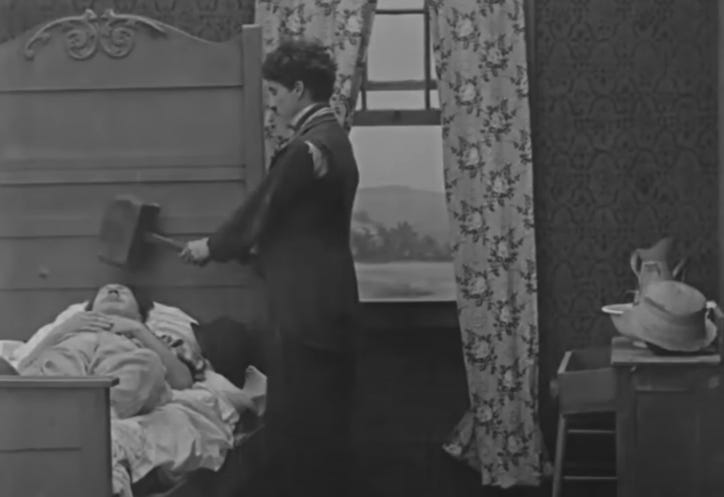
There’s a scene in The Tramp (1915) where Charlie Chaplin’s escapades lead him to striking a set of burglars with a cartoonishly large hammer. Using cutting-edge movie magic, they all seem to take the full force blows, before waltzing away in a sort of daze. Audience laughs.
Western audience, that is. Because when they took this film global, to places that didn’t have filming or screening technology yet, and showed The Tramp off as an example of what was to come, the audience didn’t laugh. They inferred that people in America had a superhuman ability to withstand hammer blows.
Point is this: if you don’t understand the rules of the game, you’re going to believe everything you’re told. And even when something is just low stakes entertainment, you can end up with some foolish theories about the outside world.
In completely unrelated news, I see the Atlantic have a new op-ed about The White Lotus out.
I.
I have two working hypotheses about The White Lotus.
Hypothesis one: This is a visually pleasant, entertaining way to spend 60 minutes per week, with a vaguely interesting plot. Plus you get to chat to your friends and coworkers about it, which is a great way to maintain human connection. 99.9% of the audience are watching for these reasons, and any attempt to make it any more than that is a symptom of too much time spent drinking IPAs and/or on substack, One should just enjoy it for what it is.
Hypothesis two: Shows like this actually do have something to say and that does matter for some reason.
In the event that hypothesis one ends up getting rejected down the line, we may as well talk about it now.
The Guardian’s review summarises the recent season of the show:
As ever, [Mike] White has his eye on the wilful ignorance and hypocrisies of the US economic elite. The power dynamics around sex and class come under scrutiny once more, but this time religion is interrogated too. Specifically the western appropriation of eastern faiths and practices – you know, the good bits; the bits that can be packaged as vague “spirituality” rather than an organising principle around which to build a moral life.
OK, OK. Let’s get the most obvious take in the world out of the way so we can get to the good stuff:
The White Lotus isn’t a show about the Western economic elite. It is a show watched by the Western economic elite who pretend to each other that they are something else. Whether that’s the Richard Osman/The Rest is Politics/’Isn’t JD Vance a weird guy’/Taskmaster and bed by 10 kind, or the Adam Friedland/YouTube video essays/’What’s the best pizza in London’?/Reddit thread-wielding variety. Both watch this show and laugh at the sad rich people yet invariably by around episode 4 say/hear the words ‘babe, I kinda want to go to Thailand next year’.
The question becomes what purpose that serves to anyone. The Atlantic gives us a clue here:
Viewers crave yachts, and hot people, and terrible mistakes, and hot people making terrible mistakes on yachts. Give them that, and underneath you can smuggle the message that it’s all incredibly hollow and unfulfilling. After a decade when too many television shows had the tone of a Sesame Street episode on healthy eating, White’s formula of miserable rich people in sunny climates is a huge relief.
Saying that the message about elites being hollow is smuggled into this show is a bit like saying American Airlines Flight 11 was smuggled into the World Trade Center. I would argue it is the entire point of the operation. But what exactly is this message, and how is it delivered?
The Atlantic’s argument is that the show thrives off being counter cultural. Mike White says things others are afraid to, and is willing to tell his audience that they aren’t perfect either, i.e.
White’s most countercultural belief is that a heavy focus on identity is a prison, not a liberation. He told Sullivan that his time as an actor made him feel limited by his appearance, whereas writing allowed him to explore the way that “we’re all monkeys, first of all—we’re all apes—and we also share so much.”
And the show does posit itself as this exploration of identity and modern narcissism, which is suspicious, because it’s operating approximately two decades and at least one simulacrum too late. I suppose that is a necessary part of the deal of being on television, but it nevertheless is the defining limitation of the medium (where else do people get their ideas from?).
Put it this way: the real life Saxon isn’t wearing chino shorts and oxford shirts, hitting poolside babes with faux-alpha pick-up lines. He’s wearing Salomons and is working on his patchwork tattoo sleeve. He’s in your Hinge dms right now hoping that he gets to say he voted Kamala, before asking you if you’ve been watching “this great show The White Lotus?”. I hear it has some really interesting things to say.
The Atlantic again:
The White Lotus repudiates the “peak woke” era of the late 2010s, which yielded safe, self-congratulatory, and didactic art, obsessed with identity and language, that taught pat moral lessons in an eat-your-greens tone. Instead, White has made a point of discovering our last remaining taboos—kink, scatology, marrying for money, male nudity deployed so frequently in moments of high tension that culture scholars call it the “melodramatic penis”—and then putting them all on-screen, with a luxury hotel or a superyacht as the backdrop.
I don’t deny the show puts things on the screen that I wouldn’t usually talk to my friends about, but what is it doing with it? What exactly are we discovering here?
Hotel Concierge once wrote in a critique of Bojack Horseman: ‘When a work of art is praised for “asking the questions,” nine times out of ten that’s because its answers are shit. The critical mistake here is to think that content can overcome structure. However harshly BoJack’s plot rejects sitcom answers, it still follows the sitcom formula: 1-2 topical issues per episode, hamster wheel character development, punchline before scene cut with a hand-holding jingle.’
And The White Lotus can’t get away from just being a murder drama either. Which is OK. Agatha Christie is still S tier entertainment. But the issue is when the ‘themes’ and ‘explorations’ escape out of the bounds of the 60 minute Sunday slot, and suddenly we have a discourse over what this means for modern society.
To put it frankly: you need to be careful about taking a story and claiming it has anything to do with reality. And when the critical reception of the story is based off a biased unconscious desire of the audience, you’re definitely going to have a bad time.
Probably the most discussed moment of the season is described by The Atlantic here:
At first, he took Asian women home for sex, but he began to find that boring. “Maybe what I really want,” Frank goes on, “is to be one of these Asian girls?” In a monologue punctuated by Rick’s occasional raised eyebrows, Frank describes how his behavior escalated. His quest for sexual satisfaction culminated in him buying lingerie, inviting white men over to “rail” him, and paying Asian women to watch them. This behavior led to a kind of spiritual awakening. “Am I a middle-aged white guy on the inside, too?” Frank wondered. “Or inside, could I be an Asian girl?” Eventually, he realized he had to stop “the drugs, the girls, the trying to be a girl.” So then Frank took up Buddhism—a religion that multiple characters in this season see as the antidote to Western materialism and their own obsessions.
Throughout Frank’s monologue, Rick looks perplexed—as well he might. But on X, Ray Blanchard—a real-life researcher who coined the term autogynephilia to describe men’s sexual arousal at the idea of themselves as women—expressed delight about the scene. Many in the LGBTQ movement have dismissed autogynephilia as a slur that reframes some trans women as nothing more than men with a fetish. Out Magazine recently described Blanchard’s idea as “a widely discredited pseudoscientific theory from the 80s.” And yet here it was being discussed on television’s buzziest show.
Look, I don’t deny the scene was very well executed, but what exactly are we discussing here? I saw the show getting touted as extremely brave for ‘tackling autogynephilia’, but this is simply acknowledging it exists. Lines like ‘Or inside, could I be an Asian girl?’ are memorable, but none of the words mean anything. Yes it dwells on it long enough for you to think something poignant is happening, but sometimes people dwell on which shoes to buy just to make it feel like that decision matters too.
The mistake is not on Mike White for doing this without any actual depth. The mistake is on the critic class for thinking anything beyond this is possible. Shows built for entertainment cannot help you develop attitudes that reflect that real world nature of things like sexuality and gender, and nor should you even want them to try to. I’m not saying the people on White Lotus aren’t based on things the writers truly encountered, but if you try to take things back into the real world from what you’ve seen on the show, you’ve agreed to no longer live in reality.
The Ratcliff Mom saying “She needs to learn to fear poverty, Tim, like everyone else we know” is funny, but if any part of you thinks this is even a caricature of something real then forgive me if I don’t think you’re watching this show to challenge yourself. Just like how saying that guy talking through the act of getting Bonnie Blued by the residents of Koh Samui is ‘tackling autogynephilia’ is like me eating a banana and claiming I’m tackling the concept of potassium.
Which means the question then moves onto why there is such an appetite to see shows like The White Lotus as more than what they are, i.e. soap operas?
What’s the real purpose?
A reminder of the Guardian’s opener: “White has his eye on the wilful ignorance and hypocrisies of the US economic elite. The power dynamics around sex and class come under scrutiny once more.”
I’m not saying the displayed hypocrisies are inaccurate. I’m saying that if you build up the courage to tell your manager in your weekly 1:1 that you have serious issues with the company and how it’s structured, and they enthusiastically agree with you, you might wonder if something else is going on.
Which is why you should also wonder if something else is going on with this show being one of the biggest things on TV. HBO sells what the audience is willing to buy, and throughout history and the future that will largely amount to what they want to hear, which is identical to what they already think. And what the modern educated sophisticated TV enjoyer thinks is that for some reason they are not part of the elite, and there’s another one above them calling all those horrible shots.
This next part is harsh but true.
There’s nothing people who are afraid of their own power (i.e. 95% of people) want more than a vague notion of authority operating at a level they can’t touch. And thus, nothing is ever your fault. Thus, nothing, especially you, ever has to change. Except for those nasty rich people, of course.
The White Lotus is for taking modern audiences to new depths and uncomfortable truths? Please.
The White Lotus is for ensuring that everything stays exactly the same.
Which is why if they want to boost their chances in 2028, the GOP could do a lot worse than funding another 4 seasons of this show. Except maybe next time don’t make the literal Trump voter one of the only half-redeemable people on screen. Haven’t you people heard of subtlety?
Look, the show’s pretty good. Its messages are probably pretty good too. But you can’t outrun your medium. And the medium’s message comes first.
Which does make it somewhat funny that the Guardian review managed to end with this:
As the Final Girl, Belinda remains impervious to The White Lotus’s ethos: a deceptively cynical view on the human capacity for progress, enlightenment or marginal betterment, particularly in the face of potential material sacrifice or social discomfort. In other words, a resistance to change.
Oh, man. You have no idea just how true that is.
II.
OK, well here’s where things get a little bit less trivial.
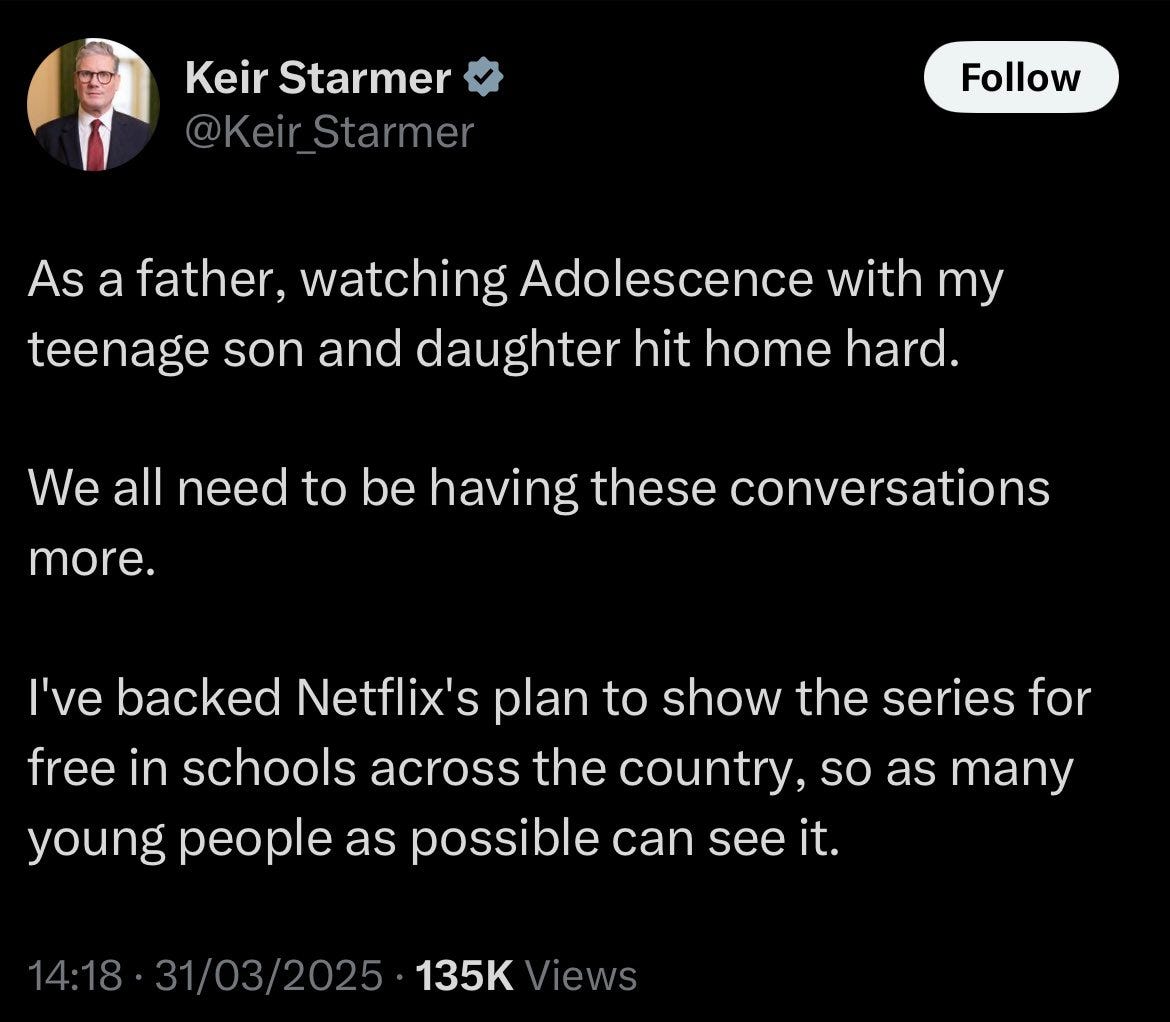
(note: this has barely anything to do with the manosphere, incels or Keir Starmer. these are not views on those specific things. it’s a more general process.)
Adolescence is good, maybe even great, which makes it a more interesting case.
The show is posited as valuable for young people, which is suspicious, because everything about it is crafted for adults. The online references are out of date, or straight up invented, and every piece of exposition is written for the 30 year-olds who already have a vague idea that this sort of thing is going on. On top of that, the number one reason I know this show is only meant to serve adults: every child in the school speaks like they’re about 25. In Episode 2, the detective’s pubescent son lets him know that the red pill is a “Call to action by the manosphere”, in the same tone as the rules of the galactic order get explained in a Star Wars film.
And given we’ve only got four episodes to deal with, there isn’t even that much explaining what the theme of the show even is. We hear Jamie’s been exposed to ‘that Andrew Tate shite’, and hear he’s getting called an incel by everyone at school. But what exactly are we discussing here? What are we discovering?
We learn that the boys resentment and eventual rage was part caused by a sort of brainwashing common to 13 year old boys. They get told a narrative that suits what they want to hear, they take it at face value, build their worldview around it, and end up powerless as a result, just pushing themselves deeper into a despair that eventually erupts. Makes sense. So how bad’s the problem? How do we stop it?
Stephen Graham says “we’re not pointing the finger specifically at any one thing, we’re saying let’s just talk about this”. Hey, remember what we said about shows that get praised for just asking questions?
And Adolescence can’t get away from just being a murder drama either. Which is OK. Agatha Christie is still S tier entertainment. But the issue is when the ‘themes’ and ‘explorations’ escape out of the bounds of the 60 minute slot, and suddenly we have a discourse over what this means for modern society.
Jack Thorne, the writer of Adolescence, puts it like this: “[Jamie] comes from a good background, like me; he’s a bright boy, like I was. The key difference between us? He had the internet to read at night whereas I had Terry Pratchett and Judy Blume.”
I’m sorry, but what? If Terry Pratchett is the difference between you murdering a young girl or not, then I’m pretty sure that’s what we need to be giving to schoolboys. But in any case, such a bizarre simplification is OK on a Netflix show, but that is it.
I mean, the fact that this could be assumed to be a good enough representation of school life is bad enough, but add into the mix that this isn’t even based on anything that’s ever happened, and suddenly you have enough layers of simulation to make even Baudrillard shit himself.
If Stephen Graham is hurt by some real life events he’s heard about, and chooses to make this great piece of art, and it touches some its audience, that’s great. But if you take that piece of art and then try to apply it back to the real world, you are actively choosing to not live in reality. Sure, it can’t directly hurt. But there’s an opportunity cost to these things.
And what’s next? Showing The White Lotus to explain class dynamics? What’s the difference?
Which is why you should be suspicious that something else is going on here.
I find it interesting that Thorne mentions he had books while boys today have the internet. Because it’s not true. He had mass media. TV and film had essentially killed books already. Why doesn’t he mention it?
It seems funny to me how the emphasis on the massive effects of social media on young people takes attention away from the massive effects of media full stop.
TV back then and Netflix today sell the same thing: whatever the audience is willing to buy, and throughout history and the future that will largely amount to what they want to hear, which is identical to what they already think.
So when Keir says he wants to have these conversations, what does he mean? It doesn’t seem to me like there’s a conversation at all? Phone bad. Social media bad. Tate bad. Incels bad.
Everyone thinks that already. The trick is making you think that adding Stephen Graham and £50m somehow makes this a more complex and nuanced look at incel culture that really gets at the causes of this stuff. It doesn’t, and it shouldn’t.
Look, the show’s very good. Its messages are probably pretty good too. But you can’t outrun your medium. And the medium’s message comes first.
Groups of people taking a narrative they want to hear at face value, building their worldview around it, and ending up powerless as a result?
Huh. I thought that was a 13 year old boy thing.