Why did Slavoj Zizek write copy for Abercrombie & Fitch in 2003?
the wrods thmesevles dno't mtaetr aynmroe
merry christmas. see you in 2025.
I.
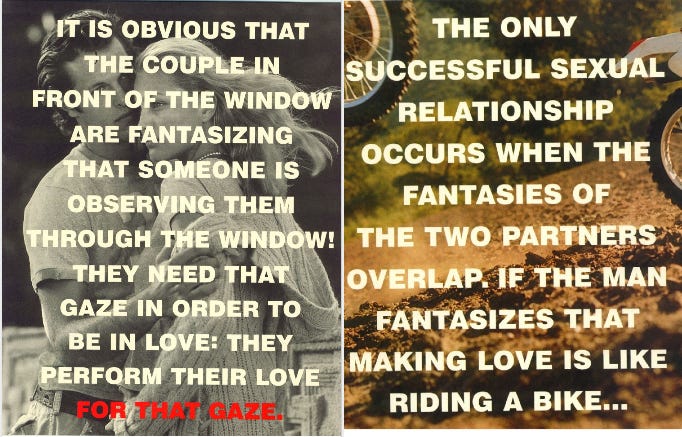
You ever see these before? They’re actually real.
The 2003 ‘Back to School’ catalogue came when Abercrombie were at their all-time aspirational Americana high. Logos were cool. Cars were cool. Sex was cool. Even some politicians were cool. Just so long as they were having sex. And it was then that Abercrombie reached out to the sexiest philosopher on this side of cable television to write their ads for them.
You can find the entire thing here, but to save you some time, the images of the catalogue feature every single generic person you’d expect doing every little thing you’d expect. Except every second page or so features sprawling messages like those above which are all .. well .. very Zizek.
Ok, let’s waste no time. Zizek is a Marxist. For all intents and purposes, he is to the 21st Century, the Marxist. He criticises the structures, ideologies, and effects of capitalism, and points to brands and corporations as the actors that seek to shape and sustain our desire for their own ends. Which keeps that exploitation train rolling, leaving the commodification of everything in its rear mirror. Or something like that.
Immediate question is why he then allows himself to become a commodity by doing this and ‘selling out’. And I think a fair immediate answer is that accepting a bag just to write some philosophical vagueries is valid as hell. So no critique for the man himself here.
The better question is what Abercrombie wanted out of him. Why would Teen Hedonism The Brand want to associate itself with the guy that I can only imagine would see them as the end of culture? Cui bono?
I guess the target market is something like ‘people who know who Slavoj Zizek is and would be secretly pleased by recognising him, but have never actually read a page of his work’. Pretty niche, right? Oh wait, that’s everyone.
So the polo shirt platonic ideal of the status quo finds a use for the fiery bohemian rebel, and he essentially becomes another product in the catalogue. He has become a symbol, a commodity. And stocks are booming.
Hey, Zizek may not like capitalism, but capitalism sure seems to like him.
How come?
II.
Around 1100 BCE, Israel changed from being ruled by local religious leaders to being ruled by Kings. This story gets told through the Book of Samuel.
(interpreted before by Lou Keep here)
Samuel himself was the last of the local leaders or ‘judges’, who interpreted the laws and handled individual disputes. You go to Samuel with your strife, and God speaks directly through him. Your second cousin two villages away has their own Samuel, who gets their own bit of distributed authority.
But ancient Israel was surrounded by growing powers, and the people noticed what they all had in common. They were Kingdoms. So they demanded that God give them a King too.
Through Samuel, God warns them what a King will do:
“This is what the king who will reign over you will claim as his rights: He will take your sons and make them serve with his chariots and horses, and they will run in front of his chariots. He will take your daughters to be perfumers and cooks and bakers. Your male and female servants and the best of your cattle and donkeys he will take for his own use.
When that day comes, you will cry out for relief from the king you have chosen, but the Lord will not answer you on that day.”
But the people refused to listen to Samuel. “No!” they said. “We want a king over us.”
Saul is chosen as the first King, and does everything God expected him to do. He becomes very unpopular, and God decides that David will replace him.
Unlike Saul who only embodied the warnings about kingship, David represented something new - he was both a powerful king who abused power and a religious poet who wrote psalms about humanity's relationship with God.
Divine truth was no longer spoken directly through prophecy, it was interpreted through art. The medium had changed. Truth is mediated.
Meanwhile, Samuel is still around as a direct channel to God. He was still walking around making prophecies, and attempting to offer truth to the people. But they wouldn’t listen, because that wasn’t how it worked anymore. He wasn’t speaking in psalm or metaphor, so he couldn’t speak at all. And as long as you did speak through those mediums, even the most confused or self-serving message gets consumed by the masses.
You know that part halfway through Runaway when the orchestra starts, and Kanye distorts his voice enough that all you hear breaking through is an autotuned hum of whatever he’s trying to say? And it’s almost like you’re just left with the feeling, and that the words themselves don’t matter anymore?
That’s what happens in the Book of Samuel, and that’s pretty much how I feel about most social commentary.
Because for all intents and purposes, Zizek could have written fucking anything on those stills of preppy couples and it wouldn’t have mattered. So long as the shape was right, and it had that ‘Karl Marx meets Groucho Marx’ feel. It would serve its purpose, and Abercrombie gets their vibe of bohemian meta-intellectualism.
And while this is one specific example, what sits behind it are two precise processes that are efficient across domains.
The first is the dominance of form over content, in the McLuhan or Neil Postman way. The medium - how something is said - matters more than what is actually being said. Just as Samuel's direct prophecies from God became ineffective once kingship changed how truth could be received, Zizek's analysis layered over fashion photos works because it matches our expectations of what critical theory should look and sound like, not because of any actual insight in the words. McLuhan and Postman then argued that electronic media - first radio and television, then computers - created an unprecedented dominance of form by severing messages entirely from physical reality: when all communication becomes abstract signals, we lose our innate ability to ground meaning in anything. No one’s words matter anymore.
Capitalism ends up liking its biggest critics because the consumer economy is fuelled by aspiration, and when language becomes visual, those critics become tradeable, and the more intricate the symbols of status anxiety become, the higher their stock rises. I doubt many people would disagree that the average East Village ALD-wearing, small plates-eating, petition-sharing, substack-reading, orange wine-drinking, Zizek-appreciating socialite is just as consumerist as the guy taking a picture with his gold-flaked steak in Salt Bae’s restaurant in Knightsbridge. But to the extent that the former is the beginning of a pricey path of never-ending aspiration and self-dishonesty, it’s probably quite a bit worse.
The second process behind the Abercrombie campaign is the consequential dominance of map over territory. When the form of a new medium demands more colour, more visuals, and more efficiency in what one tries to say, you inevitably create an abstraction. The content is slave to the form, and when that new form inevitably starts to dominate, the content is never to be found again. Zizek might take a payday and accept he is being sold symbolically to aspirational young people who just want the feeling of philosophy without having to remember any of the words. But he doesn’t get to keep his original form too. And put it this way, it is not a surprise that the most well known current philosopher is also the one with the most recognisable mannerisms and snackable quotes. And it is not a surprise that this is all everyone pretty much knows about him at all. It is in fact, by design.
This ad campaign isn’t showing that intellectualism is being reflected in mainstream culture, it is showing that when mainstream culture totally transfers and transforms it, nothing else remains.
First an image describes the original, then it replaces it.
III.
Those ads were from 2003, and we’ve had 20 years of mediums shifts since, so what is the new state of play of commentary?
For a case study, I nominate the biggest discourse-starting piece of media from the last couple years: Barbie.
A reminder of what happens:
Barbie, who lives in the perfect world of Barbieland, starts experiencing existential thoughts and flat feet, leading her to venture into the real world with Ken to find the human who's playing with her and causing these problems. In the real world, while Barbie connects with a teenager and her mother to understand what it means to be a woman, Ken discovers patriarchy and brings it back to Barbieland, turning it into a male-dominated society. Barbie returns to find her paradise transformed into "Kendom" and must work with the other Barbies to restore balance, while also grappling with the choice of whether to become human. Finally, Barbie chooses to become human and experience the full range of real emotions and experiences, while the Barbies and Kens of Barbieland learn to create a more equal society.
It was entertaining, and provided some interesting questions on what it means for a company like Mattel to fund something with this kind of self-critical message. But those questions are actually unanswerable, because once you start to dwell on it you realise there is no self-critical message. There is no message, at all. It’s unclear what women should take away. It’s unclear what men should take away. The best looking woman I’ve ever seen telling me not to care about my appearance. Got it. It’s not cohesive, but the crucial thing is that this doesn’t matter. People will write think-pieces about it anyway, and they’ll get applauded too.
To overly repeat myself, this is not a critique of Gerwig’s worldview. It is a critique of the medium. Barbie doesn’t fail to provide a complex commentary on the nature of gender roles and economics because it wasn’t thought through, or because of corporate interest. It fails because it is impossible to make a film do that. Just like how Nike could put actual videos of their sweatshops in their Christmas ads, and they’d probably still help them move more shoes.
What is possible is to make a film that feels like it’s doing commentary, which is enough to satisfy a reasonable amount of people (I respect that it actually didn’t review that well in the end, but numbers don’t lie). And when someone is selling a map it is worth considering what people will buy that in lieu of territory, for example:

The issue isn’t the aspiration. That’s pretty necessary. The issue is what shortcuts towards it you can get offered, especially when the system has a very large marketing budget.
IV.
Now that the straight white guy trying to talk about Barbie a full year too late has probably taken the numbers down, time for some amoral life advice. You don’t have to be the buyer, you can play seller too.
Modern mediums are vibe based, and specifics barely matter. So if you want, use that to your advantage. Play by the ‘rules’ of the form. As long as you do that, you can actually do whatever you’d like and no one’s going to notice.
Want to build a streetwear brand? Drop a lookbook with grainy film photos, mix in some vaguely anti-establishment copy about 'community', add artificially limited stock numbers, and you've basically printed followers. The actual clothes could be Gildan blanks - master the form and you're selling emotion, not cotton.
Want to succeed on substack? Drop a few references to Freud or Borges, throw in something about how Netflix shows are actually about capitalism, write like you're always slightly above whatever discourse you're critiquing, and you've unlocked the same exclusivity as the magazines that used to gatekeep culture writing. Bonus points if you format your titles ‘On the X-ification of Y’ or ‘A, B and C’, where A is a political figure, B is a pop artist, and C is a sociological theory you heard about last week. Yes, this is vaguely self-referential.
One more example.
When it comes to dating apps, the common advice is use the six photos to show every aspect of yourself, so people can see how many angles you’re cool from, which should also maximise the amount of different types of people that will be interested in you. This is wrong. Depending on your goals.
Fellas, if you want your ideal match, give her the type of guy that the person she thinks she is would go out with. Aspiration sells, so put nothing else on offer. Those six pictures should all say the exact same thing, and they will find their own target market. If you want to play the game that way, the next stages become a formality.
And when your first date’s coming to an end, and you stumble over the line you came up with when you went to the bathroom, and she starts to think you might not be the type of guy she thought you were, tell her something to get the story back on track. Tell her “don’t worry, the words never mattered anyway”.
First you just looked like the thing she wanted, then you replaced it.
That one’s actually Baudrillard. Keep an eye out, you might see it in an Apple campaign next year.
